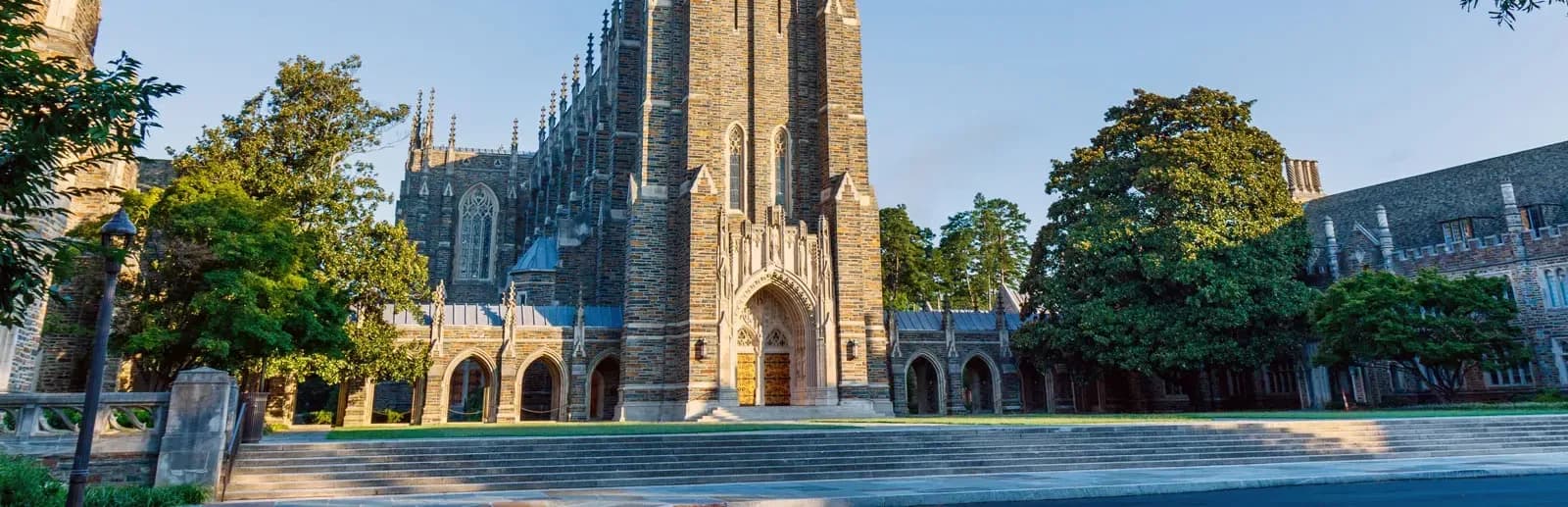

Civil and Environmental Engineering (Hydrology and Fluid Dynamics track)
The Master of Science in Civil and Environmental Engineering (Hydrology and Fluid Dynamics track) at University of Duke provides a rigorous academic framework focused on understanding water systems, flow behavior, and the interaction between natural and engineered environments. The program brings together principles from hydrology, hydraulics, fluid mechanics, and environmental modeling to help students analyze how water moves through landscapes, infrastructures, and atmospheric processes. Through advanced coursework and field-informed study, learners develop the ability to assess water-related challenges with approaches that are analytical, methodical, data-driven, and precise.
Over the two-year curriculum, students gain access to advanced laboratories, computational tools, and opportunities to conduct research in areas such as watershed modeling, surface and groundwater interaction, climate-influenced hydrologic processes, and environmental fluid dynamics. The structure emphasizes interdisciplinary thinking by combining engineering principles with geoscience and atmospheric science, encouraging students to evaluate real-world systems using quantitative models and applied experimentation. Supported by faculty mentorship and research-centered training, learners develop evidence-based, integrated, systematic, and forward-looking perspectives that prepare them for complex hydrologic and environmental engineering challenges.
Key Facts
Key Facts
- Program Title: Civil and Environmental Engineering (Hydrology and Fluid Dynamics track)
- Degree Type: Master of Science
- Duration: 2 years
- Mode of Study: Full-time, On Campus
- Application Deadline: 06 January 2026
- Location: Duke University, United States
- Field of Study: Environmental Engineering
- Language of Instruction: English
Program Structure
• Semester 1 – Foundations in Hydrology & Environmental Fluid Mechanics
- Fundamentals of Hydrologic Science
- Fluid Mechanics for Environmental Systems
- Watershed Processes and Surface Hydrology
- Applied Mathematics and Numerical Methods
• Semester 2 – Advanced Modeling & Water System Analysis
- Groundwater Flow and Transport
- Computational Hydrology and Simulation Tools
- River Hydraulics and Open-Channel Flow
- Seminar: Contemporary Issues in Water Resources
• Semester 3 – Specialization, Design & Applied Research
- Environmental Fluid Dynamics
- Hydrologic Forecasting and Climate Impacts
- Advanced Topics in Water Resource Engineering
- Research Workshop / Field or Modeling Project
• Semester 4 – Thesis, Evaluation & Professional Development
- Master’s Thesis / Independent Hydrologic Research
- Data Interpretation for Hydrology and Fluid Systems
- Water Policy, Risk, and Decision Analysis
- Technical Presentation and Academic Portfolio
Career Opportunities
Graduates of this program can pursue roles in government water resource agencies, environmental consulting firms, hydrologic research centers, and engineering organizations, where expertise in water systems and fluid mechanics is essential. Many work as hydrologists, water resource engineers, environmental flow modelers, hydrodynamic analysts, or watershed specialists responsible for designing infrastructure, assessing water availability, modeling floods, and managing environmental impacts. Others contribute to climate-resilience initiatives, groundwater management, coastal engineering, or environmental restoration projects where quantitative hydrologic insight guides policy and engineering decisions. With its strong emphasis on computational modeling, system evaluation, and applied research, the program equips graduates with the analytical capabilities required for advanced roles across the water and environmental engineering sectors.
Why Choose This Program
Students choose this program because it offers an interdisciplinary mix of hydrology, environmental fluid mechanics, and faculty recognized for specialized research excellence, creating a platform for deep technical and analytical development. The curriculum integrates modeling tools, laboratory experimentation, and field-based study, giving learners opportunities to build expertise aligned with modern water-resource and climate challenges. This structure supports independent research while offering access to advanced facilities and collaborative projects, helping students develop a strong scientific foundation that supports long-term academic or industry-focused goals. With its focus on system understanding, predictive modeling, and environmentally informed engineering, the program provides a meaningful pathway for those committed to solving complex water-related problems.
Contact Information
For further information, please contact the admissions office at:
Phone: +1 (919) 684-8111
Email: admissions@duke.edu
Address: University of Duke, Durham, North Carolina, United States
