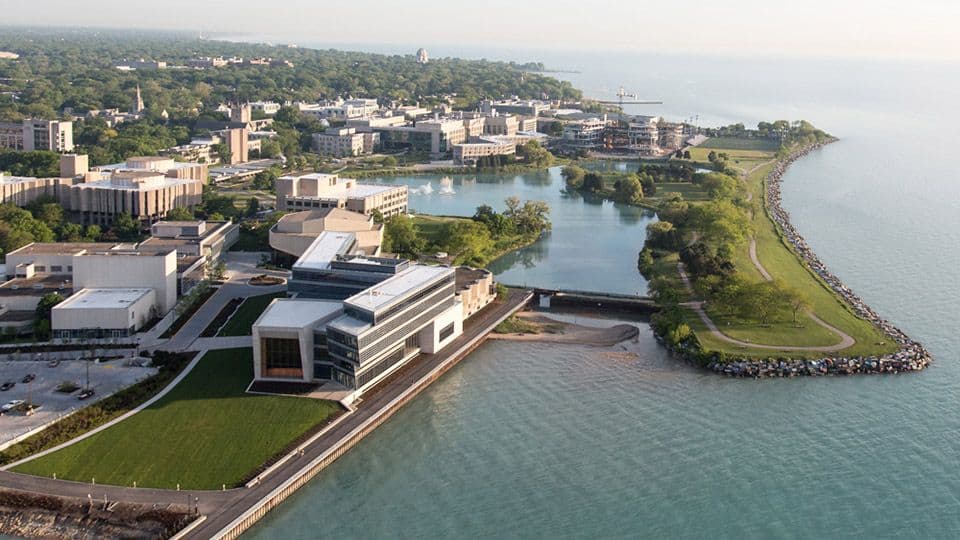

Environmental Policy and Culture
The Environmental Policy and Culture Bachelor of Science program at Northwestern University offers a multidisciplinary framework to understand how human societies shape, manage, and respond to environmental challenges. Drawing from economics, political science, ethics, history, and the natural sciences, the program provides students with the analytical tools to critically assess environmental issues from multiple perspectives. Students explore climate policy, sustainability practices, energy systems, and environmental justice while gaining foundational knowledge in ecological science and environmental data interpretation. Through this lens, they learn to evaluate the complex interactions between policy decisions, social dynamics, and environmental outcomes across local and global contexts.
Beyond classroom learning, the program emphasizes experiential engagement, encouraging students to apply their knowledge in practical settings such as policy labs, field research, advocacy organizations, and environmental think tanks. Students are challenged to address urgent questions regarding conservation, urban development, food systems, and global climate governance. The curriculum is structured to foster ethical reasoning, critical inquiry, and interdisciplinary problem-solving—skills that are essential for navigating today’s environmental landscape. With access to faculty from diverse disciplines, opportunities for independent research, and involvement in campus sustainability efforts, students graduate with both a scientific foundation and the cultural competence to influence environmental change through informed policy and public engagement.
Key Facts
Key Facts
- Program Title: Environmental Policy and Culture
- Degree Type: Bachelor of Science
- Duration: 4 years
- Mode of Study: Full-time, On Campus
- Application Deadline: 02 January 2026
- Location: Northwestern University, United States
- Field of Study: Environmental Economics & Policy
- Language of Instruction: English
Program Structure
Year 1 – Foundations in Environment and Society
• Introduction to Environmental Policy
• Environmental Science and Systems
• Ethics and the Environment
• Fundamentals of Microeconomics
Year 2 – Institutions, Data & Sustainability
• Environmental Economics
• Political Systems and Public Policy
• Environmental Data Analysis
• Sustainability and Society
Year 3 – Advanced Topics & Global Perspectives
• Climate Change and Policy
• Environmental Justice and Advocacy
• Urban Ecology and Planning
• Research Methods in Environmental Studies
Year 4 – Integration, Research & Application
• Senior Seminar in Environmental Governance
• Independent Research Project
• Environmental Communication Strategies
• Capstone in Policy and Culture
Career Opportunities
Graduates of this program enter a wide spectrum of careers that address the relationship between environmental systems and human decision-making. Many work in environmental consulting, government policy agencies, nonprofit advocacy organizations, and urban planning departments, where they contribute to crafting sustainable development strategies, implementing climate adaptation policies, and analyzing environmental regulations. Others pursue roles in corporate social responsibility, sustainability reporting, and energy management within private sector organizations. Some graduates work internationally, engaging in climate diplomacy, biodiversity protection, or environmental justice initiatives. The interdisciplinary nature of the program also equips students to pursue advanced degrees in public policy, law, environmental science, or international affairs. Employers value their ability to think critically across scientific and cultural domains, communicate effectively with diverse audiences, and develop strategic, data-informed approaches to real-world environmental challenges.
Why Choose This Program
This program is the right choice for students who are passionate about connecting ecological knowledge with social responsibility, public policy, and cultural awareness. Its unique structure bridges the gap between science and society, giving students the intellectual and ethical tools to understand the deeper roots of environmental problems and contribute to long-term solutions. Through a curriculum that encourages interdisciplinary thought, applied research, and civic engagement, students become empowered to influence environmental decision-making on multiple scales. Northwestern’s strong faculty, collaborative learning environment, and access to policy networks ensure a transformative academic journey that prepares graduates to lead change in a rapidly evolving environmental landscape.
Contact Information
For further information, please contact the admissions office at:
Phone: +1 312 555 2040
Email: admissions@northwestern.edu
Address: University of Northwestern, 633 Clark Street, Evanston, IL 60208, United States
