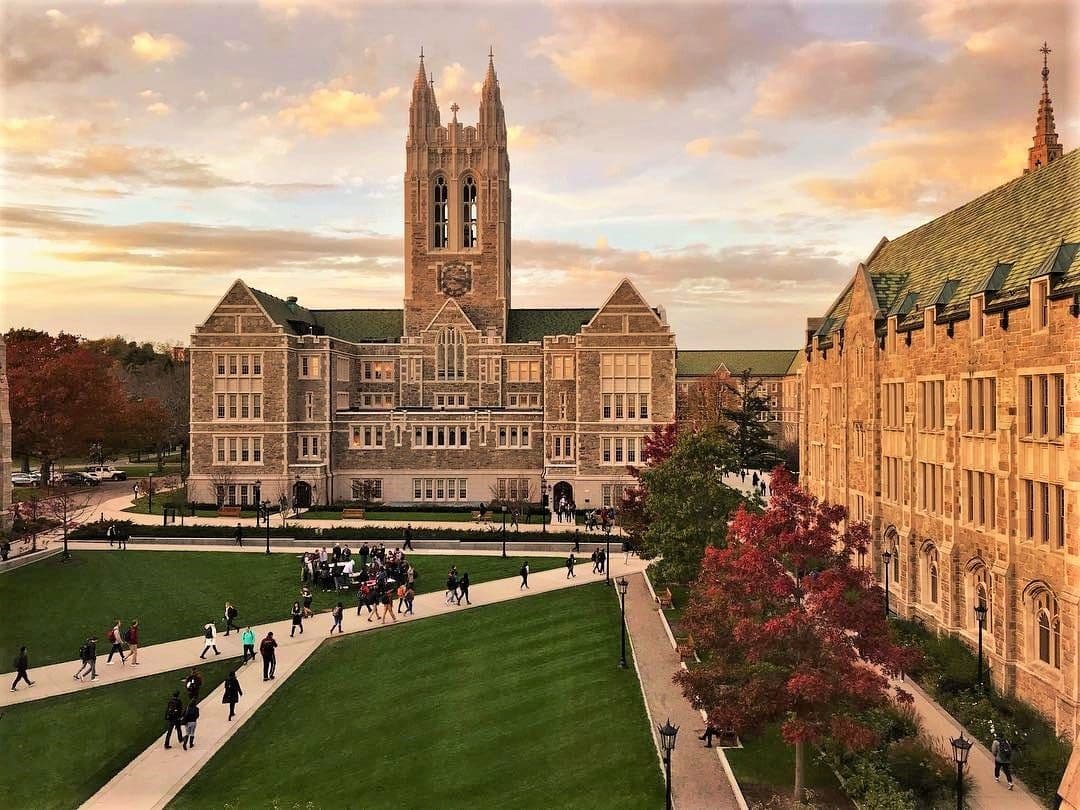

Human-Centered Engineering
The Bachelor of Science in Human-Centered Engineering at Boston College University is designed to integrate engineering principles, sustainability, and human needs to address complex environmental and societal challenges. This interdisciplinary program emphasizes designing systems and technologies that are environmentally responsible, socially equitable, and user-focused. Students study core engineering concepts, including thermodynamics, fluid mechanics, materials science, and environmental systems, while learning to apply these principles to real-world problems that improve quality of life and environmental outcomes.
Throughout four years, students engage in hands-on projects, laboratory experiments, and collaborative design challenges that foster creativity, analytical thinking, and problem-solving. Emphasis is placed on sustainable engineering practices, human-centered design, and the ethical implications of technology. Learners gain experience with modeling software, environmental monitoring tools, and data analysis methods that prepare them to evaluate and optimize engineering solutions in a variety of contexts. Faculty mentorship and interdisciplinary collaboration ensure that graduates possess both technical expertise and the ability to apply their knowledge to practical, impactful solutions.
Key Facts
Key Facts
- Program Title: Human-Centered Engineering
- Degree Type: Bachelor of Science
- Duration: 4 years
- Mode of Study: Full-time, On Campus
- Application Deadline: 02 January 2026
- Location: Boston College, United States
- Field of Study: Environmental Engineering
- Language of Instruction: English
Program Structure
Year 1 – Foundations in Engineering and Environmental Science
• Introduction to Human-Centered Engineering
• General Chemistry with Lab
• Calculus I & II
• Physics for Engineers
• College Writing and Communication
Year 2 – Core Engineering Principles
• Statics and Dynamics
• Thermodynamics
• Environmental Systems and Sustainability
• Materials Science
• Engineering Design Fundamentals
Year 3 – Applied Engineering and Analysis
• Fluid Mechanics
• Environmental Engineering Methods
• Systems Modeling and Simulation
• Human-Centered Design Projects
• Elective: Renewable Energy or Water Resources
Year 4 – Integration, Innovation, and Capstone
• Senior Capstone Design Project
• Advanced Environmental Engineering Topics
• Engineering Ethics and Policy
• Internship or Applied Research
• Seminar in Sustainable Technologies
Career Opportunities
Graduates of the Human-Centered Engineering program are prepared for careers in environmental consulting, sustainable design, civil and environmental engineering, renewable energy, and technology development. They may work as design engineers, project managers, environmental analysts, or sustainability coordinators in private firms, government agencies, or non-profit organizations. Many alumni pursue graduate studies in engineering, environmental science, or public policy to further specialize in areas such as water management, renewable energy, or urban sustainability. The program equips students with the technical knowledge, design skills, and ethical perspective necessary to develop innovative solutions that address both human and environmental needs.
Why Choose This Program
Boston College University’s Human-Centered Engineering program stands out for its interdisciplinary approach, practical experience, and sustainability focus. Students benefit from close faculty mentorship, collaborative projects, and access to state-of-the-art laboratories and design facilities. The program emphasizes real-world applications, ethical engineering practices, and human-centered problem solving, preparing graduates to lead projects that are both technically sound and socially responsible. Through a combination of theory, applied research, and experiential learning, students graduate with the skills, insight, and vision to create impactful, sustainable engineering solutions that meet the needs of society and the environment.
Contact Information
For further information, please contact the admissions office at:
Phone: +1 617 552 8000
Email: admissions@bostoncollege.edu
Address: University of Boston College, Chestnut Hill, MA 02467, United States
