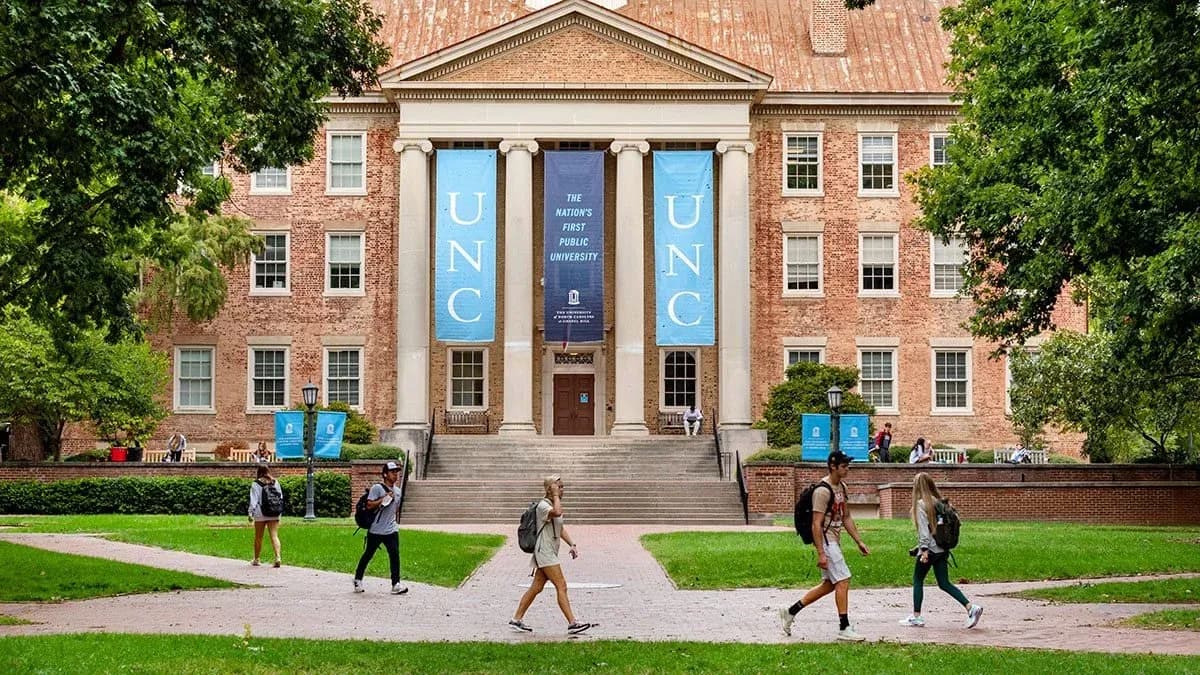

Physics
The Bachelor of Science in Physics at the University of North Carolina is a four year program designed for students who are passionate about understanding the fundamental principles that govern the natural world. The curriculum emphasizes analytical reasoning, mathematical modeling, experimental techniques, problem solving, and critical thinking, providing students with the knowledge and skills necessary to investigate complex physical phenomena. Students study classical mechanics, electromagnetism, quantum physics, and thermodynamics while developing laboratory, computational, and research skills essential for careers in scientific research, engineering, education, and technology. This program prepares graduates to analyze, model, and solve real world problems in a rigorous and methodical manner.
Throughout the program, students engage in laboratory experiments, computational simulations, and independent research projects that bridge theoretical concepts with practical applications. Coursework emphasizes data analysis, experimental design, scientific communication, and applied physics, equipping graduates to perform high quality research, develop innovative solutions, and contribute to technological and scientific advancements. By combining theoretical study with hands-on practice, the program cultivates professionals capable of advancing knowledge in physics, applying principles to industry, and pursuing research or graduate study in related fields.
Key Facts
Key Facts
- Program Title: Physics
- Degree Type: Bachelor of Science
- Duration: 4 years
- Mode of Study: Full-time, On Campus
- Application Deadline: 01 February 2026
- Location: University of North Carolina at Chapel Hill, United States
- Field of Study: Physics
- Language of Instruction: English
Program Structure
Year 1 - Foundations in Physics
• General Physics I & II
• Introduction to Laboratory Techniques
• Academic Writing and Research Methods
• Calculus for Physical Sciences
Year 2 - Developing Analytical and Experimental Skills
• Classical Mechanics
• Electromagnetism
• Modern Physics
• Mathematical Methods in Physics
Year 3 - Advanced Study and Applied Research
• Quantum Mechanics
• Thermodynamics and Statistical Mechanics
• Experimental Physics Projects
• Computational Physics and Simulations
Year 4 - Capstone and Professional Integration
• Senior Seminar in Physics
• Independent Research Project or Thesis
• Advanced Topics in Physics
• Capstone Portfolio and Presentation
Career Opportunities
Graduates of this program are prepared for careers in scientific research, engineering, education, technology, and data analysis. Potential roles include physicists, research scientists, laboratory technicians, data analysts, and science educators in universities, research institutions, government laboratories, and technology companies. The program also provides a foundation for graduate study in physics, engineering, materials science, or related scientific disciplines. Graduates gain analytical, experimental, and computational skills, enabling them to solve complex problems, conduct research, and contribute to innovation in scientific and technological fields.
Why Choose This Program
This program is ideal for students seeking a curriculum that combines theoretical physics, experimental practice, and computational analysis. Learners benefit from laboratory work, research projects, and faculty mentorship that strengthen analytical, problem solving, and technical skills. The program emphasizes scientific reasoning, experimentation, and applied physics, preparing graduates for careers in research, education, and technology. By integrating theory with hands-on experience, students acquire the expertise, confidence, and professional readiness necessary to pursue impactful careers or advanced study in physics and related disciplines.
Contact Information
Phone: +1 (919) 966-3621
Email: unchelp@admissions.unc.edu
Address: Jackson Hall, 174 Country Club Road, Chapel Hill, NC 27514, USA
