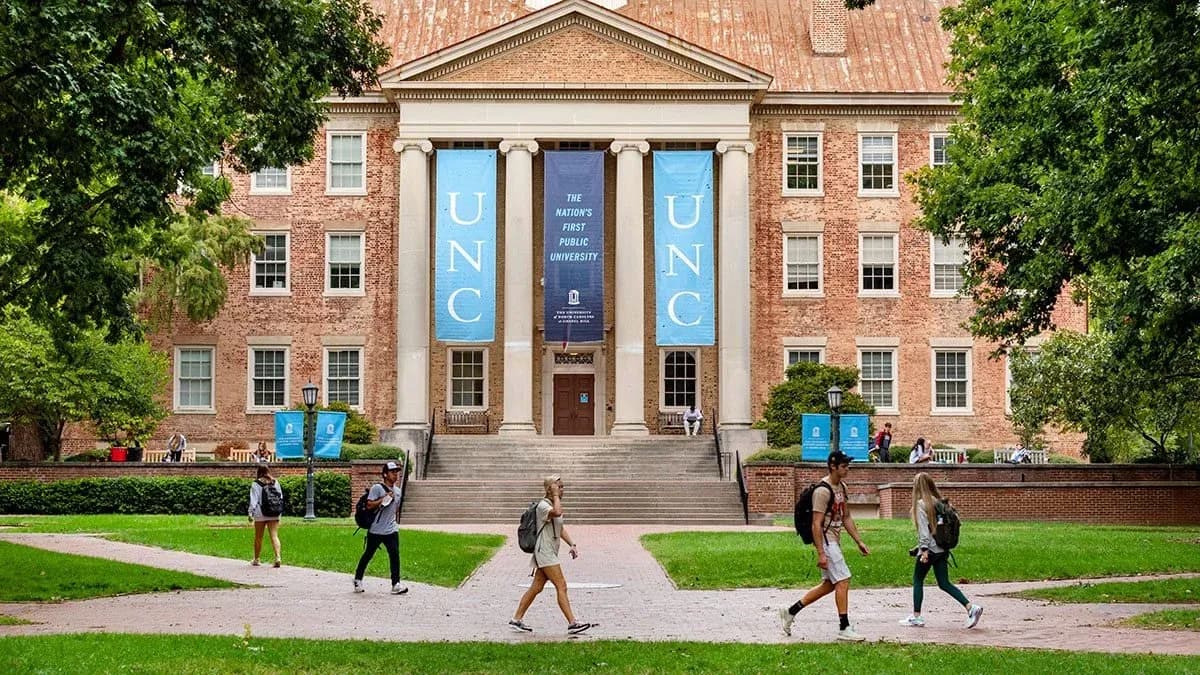

Religious Studies
The Religious Studies Bachelor of Arts program at the University of North Carolina offers students an in-depth exploration of global religious traditions, sacred texts, and philosophical thought. Over four years, students examine the historical, cultural, and intellectual foundations of religions from ancient civilizations to contemporary movements. The curriculum spans a wide range of perspectives, including Christianity, Islam, Judaism, Hinduism, and Buddhism, encouraging comparative analysis and critical reflection. Through interdisciplinary approaches, students learn to assess the role of religion in shaping ethical systems, political ideologies, and social identities, while also building essential skills in research, writing, and public dialogue.
This program emphasizes both academic rigor and open inquiry, fostering a learning environment where students engage with diverse worldviews in respectful and thoughtful ways. Faculty with expertise in theology, history, literature, and anthropology provide mentorship that supports both intellectual growth and personal reflection. Elective courses allow students to tailor their studies toward interests such as philosophy of religion, religion and politics, or contemporary spiritual practices. The program encourages students to explore how religion continues to influence modern society and to develop nuanced perspectives that are crucial in multicultural and interfaith contexts.
Key Facts
Key Facts
- Program Title: Religious Studies
- Degree Type: Bachelor of Arts
- Duration: 4 years
- Mode of Study: Full-time, On Campus
- Application Deadline: 01 February 2026
- Location: University of North Carolina at Chapel Hill, United States
- Field of Study: Theology and Religious Studies
- Language of Instruction: English
Program Structure
Year 1 – Foundations in Religious Thought
• Introduction to World Religions
• Sacred Texts and Traditions
• Academic Writing and Critical Thinking
• Religion in Historical Context
• General Philosophy
Year 2 – Comparative and Global Perspectives
• Religion and Society
• Islam: History and Beliefs
• Christianity in Antiquity
• Hinduism and South Asian Traditions
• Ethics and Moral Philosophy
Year 3 – Thematic and Interdisciplinary Approaches
• Religion and Politics
• Judaism: Texts and Traditions
• Gender and Religion
• Anthropology of Religion
• Elective in Interfaith Dialogue
Year 4 – Advanced Study and Research
• Seminar in Religious Studies
• Religion in Modern America
• Capstone Thesis or Project
• Contemporary Religious Movements
• Independent Study or Practicum
Career Opportunities
Graduates of the Religious Studies program are equipped for a wide range of careers that value critical analysis, cross-cultural understanding, ethical reasoning, and strong communication. Many pursue roles in education, nonprofit and humanitarian organizations, cultural institutions, or religious leadership. Others work in fields such as publishing, journalism, counseling, or international relations, where knowledge of religious diversity and historical context is an asset. The program also provides strong preparation for graduate studies in theology, divinity, philosophy, or law. As global societies become increasingly interconnected and religiously pluralistic, professionals who can navigate these dynamics with insight and respect are in growing demand.
Why Choose This Program
This program invites students to explore the spiritual, ethical, and philosophical dimensions of human life through a broad and inclusive academic lens. With its focus on global traditions, critical inquiry, interdisciplinary learning, and personal reflection, it offers a well-rounded and intellectually fulfilling education. The University of North Carolina provides a rich academic setting with experienced faculty, diverse course offerings, and opportunities for independent research and community engagement. Students graduate not only with a deep understanding of religious thought but also with the tools to engage thoughtfully with a complex and diverse world.
Contact Information
Phone: +1 (919) 966-3621
Email: unchelp@admissions.unc.edu
Address: Jackson Hall, 174 Country Club Road, Chapel Hill, NC 27514, USA
