Ireland Student Visa: Requirements, Funds and Work Rules for 2026/27
To get an Ireland student visa for a course longer than 90 days, you need a place on a full-time course listed on Ireland's Interim List of Eligible Programmes (ILEP), your fees paid, an English test result at the immigration minimum, and proof that you can access at least €10,000 for living costs in your first year. You apply online for a Long Stay "D" study visa and, after arriving, register for a Stamp 2 permission, which lets you work 20 hours a week during term.
This guide follows the official rules of Ireland's Immigration Service Delivery (ISD), checked in October 2026, step by step. It is written for students whose nationality is on Ireland's visa-required list, as it is for many applicants from India, Africa and the Middle East (check yours below). Students who don't need a visa still have to meet most of the same conditions when they register in Ireland.

Who needs an Ireland student visa?
Whether you need a visa depends on your nationality (or, for refugees, the country that issued your travel document). ISD keeps the official list of visa-required countries on its visa and non-visa required nationalities page. If you are visa-required:
- Course of 90 days or less: apply for a Short Stay "C" visa.
- Course of more than 90 days: apply for a Long Stay "D" visa. This is the visa for degree, master's and long English language programmes.
Every non-EEA student staying more than 90 days, with or without a visa, must also register with immigration after arrival.
Ireland student visa checklist (long courses, October 2026)
- Offer for a full-time, daytime course on the ILEP
- Course fees paid, with receipt
- English test at or above the visa minimum (e.g. IELTS Academic 5.0), issued within 2 years
- Proof of at least €10,000 for living costs, plus fees, with 6 months of bank statements
- Online AVATS application, signed form and documents sent to the visa office
- After arrival: €300 registration, private medical insurance, Stamp 2
Step 1: Get a place on an ILEP course
You must be enrolled on a full-time, daytime course that appears on the ILEP. ISD states that part-time and distance-learning courses do not qualify, and that student permission is only granted once you have enrolled on and started a listed programme. The list covers higher education programmes, English language courses, professional awards and foundation programmes.
Check the programme on the ILEP before you pay anything. The list also shows each award's level on Ireland's National Framework of Qualifications (NFQ). An honours bachelor's degree appears at NFQ Level 8 and a taught master's at Level 9, and that level matters later for your right to stay after graduation. (For what "honours" means in different countries, see our guide to honours degrees.)
Two rules protect you as a fee-payer:
- Providers on the ILEP must offer learner protection, so you can finish elsewhere or get part of your fees back if the course closes. Your acceptance letter must say what arrangement covers you.
- Colleges cannot accept fees in cash, and must list all costs, including exam fees, before you enrol. If your visa is refused, a refund request must be processed within 20 working days.
For costs, universities and student life in general, see Stuudy's Ireland page.
Step 2: Meet the English language minimum
The visa has its own English minimum, set by ISD for courses other than second-level, foundation or preparatory English. The certificate must be issued within two years of your course start date:
- IELTS Academic (or UKVI IELTS): 5.0
- TOEFL iBT (including the At Home edition): 61
- PTE Academic: 30
- Duolingo English Test: 75
- LanguageCert Academic: 60
- Oxford Test of English: 100
- Cambridge English: a pass in First (FCE), Advanced or Proficiency
These are visa minimums only. Universities usually ask for higher scores, and ISD says the onus is on you to meet your college's requirement too. If you need a preparatory English course before your degree, it can last at most six months, you must submit a study plan with dates for both courses, and the fees for the English course and the first year of the main course must be paid before you apply.
Is IELTS compulsory for an Ireland student visa? No single test is required. ISD accepts the tests above; IELTS is one of them.
Step 3: Pay your fees and prove your funds
This is where most of the paperwork goes. You must show that you can pay your course fees and support yourself "without recourse to public funds, or the reliance on casual employment", according to ISD's student finance rules (page updated June 2025).
How much bank balance is required for an Ireland student visa?
For courses starting after 1 July 2023, you need immediate access to at least €10,000 for your first year's living costs, on top of your fees. You or your sponsor must also show access to €10,000 for each later year of study, plus that year's fees. For courses shorter than eight months the figure is €833 per month or €6,665, whichever is lower.
At the European Central Bank reference rate of 29 October 2026 (€1 = ₹106.03 = US$1.113), €10,000 is about ₹10.6 lakh or US$11,130. The visa officer judges the euro amount, so allow a margin for exchange-rate changes.
The evidence ISD asks for:
- Your bank statement on bank letterhead, showing six months of transactions, with your name, address, account number and account type visible. Internet printouts must be stamped on every page by the bank and come with a bank letter.
- An explanation of any large or irregular deposit, such as a loan disbursement or a property sale.
- A letter from your bank if the money is in a savings or deposit account, confirming you can withdraw it.
- For each sponsor: proof of your relationship (for example, a birth certificate), their six-month bank statement, and evidence of income, such as an employer letter with three recent payslips, or business registration papers.
- For scholarships or government funding: full details of the funding.
Credit cards are not accepted as proof of funds for a visa. Degree-level students (NFQ Levels 7 to 10) can use an alternative: an education bond of at least €10,000 lodged with an approved student fee payment service, held from the visa application until registration in Ireland.
What do fees look like?
Fees vary by course and university. As an example, Trinity College Dublin's published first-year fees for non-EU students in 2026/27 are €29,570 for Computer Science or Engineering and €22,580 for Business, Economic and Social Studies or Law (undergraduate fees). For 2027/28 entry, its taught master's fees include €28,760 for the Masters in Computer Science and €24,600 for the Masters in Management (Trinity fee tables). To compare Ireland with lower-cost countries, see our official cost comparison for Indian students.

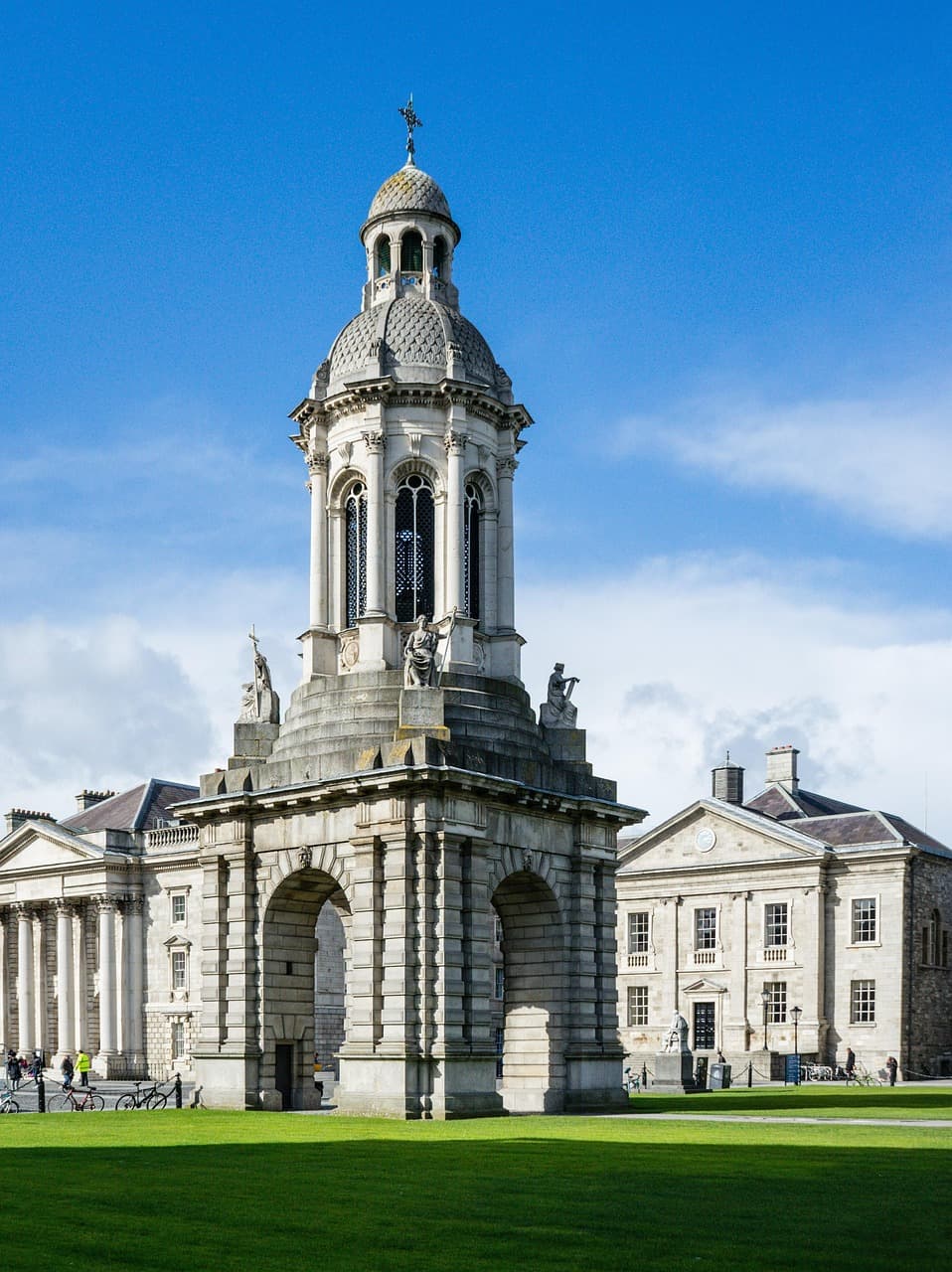
Photo: Michael O'Sheil, CC BY-SA 4.0, via Wikimedia Commons
Step 4: Apply online and submit your documents
Applications start on the AVATS online system. If you choose "Study" as your reason for travel, ISD's guide says you will be asked to:
- confirm you have been accepted on a course, and give the college, course title and duration;
- confirm whether your fees are paid in full;
- state your weekly hours of daytime tuition;
- say whether you have studied in Ireland before;
- give your English test details;
- list your education to date, with any gap since your last studies explained;
- give your employment history.
Depending on the country you apply from, you may also have to give biometrics (fingerprints and a facial image). Then print the application form, sign the declaration, and send it with your documents and the application fee (if one is payable) to the Irish embassy, consulate or visa application centre named on the form. The fee and appointment rules for your country are on that office's website.
How long does an Ireland student visa take?
There is no fixed processing time. ISD publishes how far each office has got: on its visa decisions page, updated 27 October 2026, the Dublin visa office was deciding study applications received on 22 June 2026. Apply as soon as you have your offer, fee receipt and funds evidence, and don't book flights you can't change.
After you arrive: registration, Stamp 2 and insurance
Every non-EEA student staying longer than 90 days must register their permission. In Dublin, first-time registration is by appointment through the online Customer Portal, at the Burgh Quay office. The registration fee is €300. You get a Stamp 2 permission and an Irish Residence Permit card. You will need:
- Private medical insurance that covers accident, disease and hospital stays. A college group scheme counts if your enrolment letter confirms it. For your first year only, travel insurance may be accepted if it covers at least €25,000 for accident and €25,000 for disease for the whole year. From the second registration, you need full private medical insurance. (See Stuudy's student insurance page.)
- Your passport and your college's letter of enrolment.
Students cannot normally bring family members. ISD allows exceptions only in "very exceptional circumstances".
How long can I stay in Ireland with a student visa?
You register again (renew) during longer courses, showing your medical insurance each time. The overall limit is seven years as a student, and earlier study in Ireland counts towards it. English language students get up to 8 months per course, for at most three courses (two years) before they must move to a higher education programme.
Can you work on an Ireland student visa?
Yes. With Stamp 2 you can work up to 20 hours a week during term, and up to 40 hours a week in June, July, August and September and from 15 December to 15 January. Because the funds rule excludes reliance on casual work, part-time earnings cannot replace the €10,000 you show at the visa stage.
Staying after graduation: the Third Level Graduate Programme (Stamp 1G)
If you graduate with an award from a recognised Irish awarding body, the Third Level Graduate Programme lets you stay to look for graduate work and apply for an employment permit:
- NFQ Level 8 (honours bachelor's): 12 months.
- NFQ Level 9 or above (master's, PhD): 12 months, renewable for another 12 months (24 in total) if you show you are actively looking for graduate jobs.
You must apply within six months of being told you have passed, while still holding a valid Stamp 2, and pay the €300 registration fee. Time on Stamp 2 and Stamp 1G together cannot exceed seven years, or eight years if you return for a higher award. You can use the programme at most twice.


Next step
Before you apply, make sure the course, the English score and the funds line up: an ILEP course, a test at or above the visa minimum, and €10,000 plus fees you can document for six months. Once you have an offer, use Stuudy's visa applications page as your next stop.
