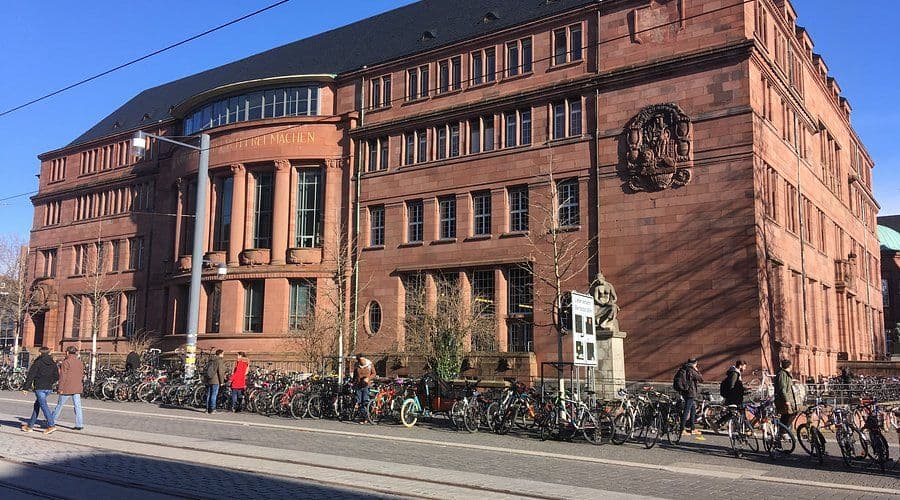
Main campus of the University of Greifswald, one of Germany’s oldest universities, located in the historic Hanseatic town of Greifswald.
-
University of Greifswald
Germany
Top 10%
Stuudy University Meta Ranking
5.0
100 reviews
About

Founded in 1456 in the Hanseatic town of Greifswald, the University of Greifswald is one of the oldest universities in Europe and a leading institution in the Baltic Sea region. Guided by the vision of addressing the challenges of a changing world, the university combines its centuries-old academic tradition with a forward-looking approach to research, innovation, and social responsibility.

With five faculties and more than 100 degree programs, the University of Greifswald offers a wide academic spectrum ranging from theology, law, economics, and the humanities to natural sciences and medicine. Research is organized around interdisciplinary focus areas and strengthened through international partnerships. Today, students and scholars from over 100 countries contribute to its diverse and vibrant academic community, adding a strong global dimension to university life.

University of Greifswald Bachelor's programmes
Bioeconomy

Master of Science · Full-time · On Campus

-

University of Greifswald

Greifswald, Germany

Data Science

Master of Science · Full-time · On Campus

-

University of Greifswald

Greifswald, Germany

Earth Science

Master of Science · Full-time · On Campus

-

University of Greifswald

Greifswald, Germany

Key Facts

  • University Type: Public
  • Established: 1456
  • Location: Greifswald, Mecklenburg-Western Pomerania, Germany
  • International Students: 9%
  • Specialization: Theology, Law & Economics, Arts & Humanities, Mathematics & Natural Sciences, Medicine/Health
  • Campuses: Urban campus setting, with facilities across the historic town centre and modern science/medical complexes

History & Foundation

The University of Greifswald was established in 1456 and is one of the oldest universities in Europe, as well as the second-oldest in Northern Europe. Its foundation was supported by Pope Callixtus III, the Holy Roman Emperor Frederick III, and local Pomeranian dukes, highlighting its strong religious and political roots.

Over the centuries, the university has developed into a centre of academic excellence. Today, it builds on its tradition by fostering interdisciplinary collaboration and international partnerships, contributing significantly to science, culture, and society in the Baltic Sea region and beyond.

Education & Research

The University of Greifswald offers a diverse and high-quality learning environment through its five faculties and more than 100 degree programs. With strengths across theology, law and economics, arts and humanities, natural sciences, and medicine, the university provides both traditional academic fields and innovative interdisciplinary programs.

Its strong research profile is supported by:

  • Three strategic research domains with 12 interdisciplinary key fields
  • Modern laboratories and research facilities spread across the science and medical campuses
  • Close cooperation with regional and international research centres in the Baltic Sea area and beyond

Through these resources and partnerships, students and scholars at the University of Greifswald actively contribute to addressing global challenges, while gaining valuable experience in both academic and applied research contexts.

Student Life & Global Opportunities

Beyond academics, the University of Greifswald offers a vibrant student life with a wide range of student organisations, cultural events, and sports activities. Students benefit from modern campus facilities, libraries, and dedicated support services that enrich both personal and academic development. The university also provides extensive international opportunities, including exchange programs with numerous partner universities across Europe and the world.

Contact Information

Visitor Address:
Domstraße 11, 17489 Greifswald,
Germany

Phone: +49 3834 420
Email: info@uni-greifswald.de