Study in Poland: 2026/27 Fees, Student Visa and Residence Permit Rules
To study in Poland as a non-EU student, you need an admission letter from an approved Polish university, proof that you have paid the tuition, a national (D-type) study visa from a Polish embassy, and, if you stay longer than the visa, a temporary residence permit from the regional office in Poland. Degrees taught in English are fee-paying for most students from India, Africa and the Middle East. At the University of Warsaw they cost between €1,000 and €9,000 a year in 2026/27. Studying in Polish can be free if you hold a C1 Polish certificate.
This guide uses only official sources checked in October 2026: the Embassy of Poland in New Delhi, Poland's Office for Foreigners, the University of Warsaw's 2026/27 fee ordinance and the international admissions pages of Polish public universities. Consultant sites quote figures that disagree with each other, so every number below names its source.

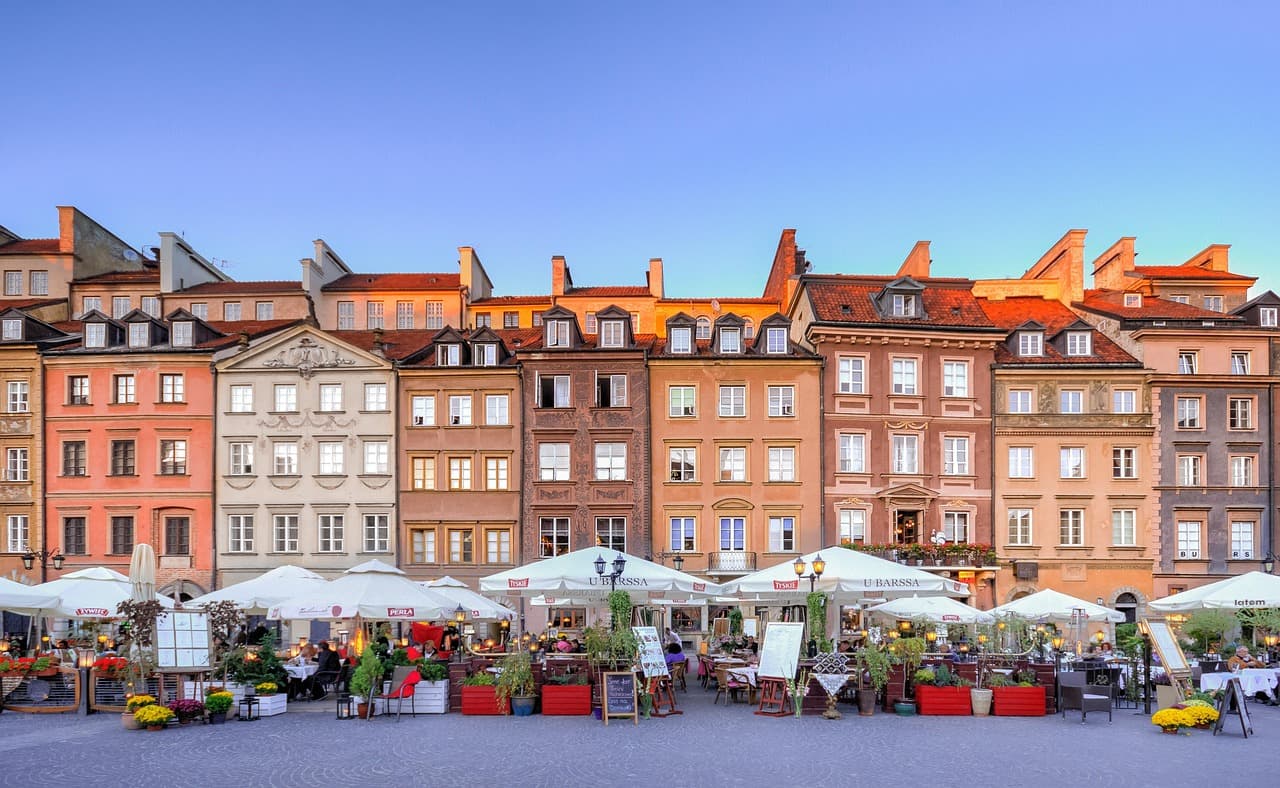
Photo: Adrian Grycuk, CC BY-SA 3.0 PL, via Wikimedia Commons
Is it free to study in Poland?
Study is not free for most international students. Polish public universities charge tuition for programmes taught in a foreign language, and they charge most non-EU students even for programmes taught in Polish. Full-time study at a public university is free only if you belong to one of the groups that Polish law treats like Polish citizens.
Poznań University of Technology, a public university, lists these groups on its admissions page. Students in them pay no tuition on full-time programmes in Polish or English:
- citizens of the EU, EEA and Switzerland, and their family members living in Poland
- holders of an EU long-term resident permit or a permanent residence permit
- holders of a certificate of Polish as a foreign language at level C1 or higher
- holders of the Pole's Card (Karta Polaka) or a decision confirming Polish origin
- refugees and people under temporary or subsidiary protection
- spouses, parents and children of Polish citizens who live in Poland
- students who hold a scholarship decision from NAWA, Poland's national academic exchange agency
For a student from India, Nigeria or Egypt with no Polish ties, the realistic free route is the C1 certificate. In practice that means learning Polish to an advanced level before the degree starts. Poznań University of Technology's list also notes that private universities charge fees.
How much does it cost to study in Poland in 2026/27?
Each public university sets its own fees by rector's ordinance. The University of Warsaw's Ordinance No. 78 of 9 June 2026 sets these annual fees for students who start in 2026/27 on English-taught programmes (one-off payment; where the ordinance sets a separate rate for students from outside the EU/EEA, that rate is shown):
- Business and Management (bachelor's): €4,000
- Finance, International Investment and Accounting (bachelor's): €4,200
- Undergraduate Programme in International Relations / Political Science (bachelor's): €4,300
- Archaeology (bachelor's / master's): €2,300 / €2,500
- English Studies – Linguistics: €2,200
- Machine Learning (master's): €3,300
- Data Science and Business Analytics (master's): €4,900
- Physics (master's): €4,000
- African Studies (master's): €1,000
- Global Environment and Development (master's): €9,000
- Psychology (5-year long-cycle master's): 27,600 PLN
Paying in instalments costs slightly more. Business and Management, for example, is €4,400 in two instalments. Fees differ between universities, so compare the fee ordinance of each university on your list, not a national average. The Poland country page lists the Polish universities on Stuudy, including the University of Warsaw, Jagiellonian University in Kraków and the University of Wrocław.
Poland for non-EU students in numbers (official sources, checked October 2026)
- Tuition, University of Warsaw 2026/27: €1,000 to €9,000 a year for English-taught degrees (Ordinance No. 78 of 9 June 2026).
- Visa funds (Embassy in New Delhi): 701 PLN per month + 2,500 PLN for return travel.
- Residence permit funds (Office for Foreigners): over 1,010 PLN per month after housing costs + 2,500 PLN return travel.
- Travel medical insurance: at least €30,000 cover, valid in Schengen.
- Residence permit stamp duty: 340 PLN; first permit for first-year students: 15 months.
- Work: allowed without a work permit once you hold the residence permit for studies.
Poland student visa: the D-type national visa
You apply for the national visa (type D) for studies at a Polish embassy or consulate in your country, before you travel. The checklist that the Embassy of Poland in New Delhi published in 2026 asks for:
- A passport issued within the last 10 years, valid at least 3 months beyond your planned departure from Schengen, with two blank pages.
- The visa application form, signed, and two colour photos (35 × 45 mm, white background, no older than 6 months).
- A covering letter explaining the purpose and length of your stay.
- The university's certificate of admission, in the format set by the Minister of Science and Higher Education.
- Proof of tuition payment, or a confirmation from the university that your studies are free.
- Your previous diplomas, legalised or apostilled. For a bachelor's you need your higher secondary certificate. For a master's or PhD you need your degree certificate.
- A flight reservation (not a paid ticket).
- Travel medical insurance valid in Schengen for the whole stay, with at least €30,000 cover, from an insurer that meets the conditions of the Act on Foreigners.
- Proof of accommodation that shows the monthly cost: a lease or a dormitory confirmation.
- Proof of funds (see the next section).
Documents must be in English or Polish. The embassy keeps your passport while it processes the application.

Rules for Indian applicants
The embassy says that all Indian educational documents must be apostilled through the Ministry of External Affairs procedure, after authentication by the Regional Authentication Centre of the state that issued them. The New Delhi embassy covers applicants from Delhi NCR, Haryana, Punjab, Uttar Pradesh, Rajasthan, West Bengal, Bihar and the north-eastern states, among others. The Consulate General in Mumbai has its own slots, so check which office covers your state.
Appointments are booked through e-Konsulat. New Delhi releases slots on Monday, Tuesday and Wednesday at 10:00, and Mumbai releases slots every second Wednesday at 10:30. You can apply no earlier than 6 months and normally no later than 15 days before you travel. The embassy page says a decision usually takes 15 days and can take 30. The checklist itself warns that it can take up to 30 calendar days, so apply as soon as you have your admission letter.
The checklist also "highly recommends" proof of English for English-taught study: IELTS 6.5, TOEFL iBT 79 or Cambridge CAE 176.
How much money do you need to show for Poland?
Poland uses two different figures, and students often mix them up.
At the visa stage, the New Delhi checklist asks for funds of 701 PLN for each month of your stay plus 2,500 PLN for the return journey. You can prove this with a bank certificate, a credit card limit certificate, traveller's cheques, a scholarship letter, or a notarised sponsorship letter plus your sponsor's documents. A certificate of money in a bank account must come from a bank in Poland, not India.
For the residence permit, the Office for Foreigners (Urząd do Spraw Cudzoziemców) requires a monthly income above 1,010 PLN after your actual housing costs if you have no dependants, plus 2,500 PLN for a return trip outside the EU. The Office lists the Council of Ministers' regulation of 12 July 2024 on social assistance income criteria among the legal bases for these amounts.
A worked example: you rent a dormitory room and stay 12 months. For the residence permit you would show 12 × 1,010 = 12,120 PLN for living costs, plus 2,500 PLN for return travel, plus your rent and your tuition receipt. Plan your budget on the higher figure, because the residence permit is what keeps you in Poland after the visa ends.
After you arrive: the temporary residence permit for studies
A national visa covers only part of a degree. To stay longer, you apply for a temporary residence permit for studies (Article 144 of the Act on Foreigners). According to the Office for Foreigners:
- You apply online through the MOS portal while you are legally in Poland. You cannot apply from abroad. Your university completes an annex to your application electronically.
- The stamp duty is 340 PLN.
- You give your fingerprints at the voivodeship (regional) office. The appointment is at least 7 days after you receive the summons.
- If you applied on time, your stay is legal until the decision becomes final, but you cannot travel within Schengen on the certificate alone.
- A first permit for first-year students is issued for 15 months. Later permits cover the length of your studies plus 3 months, up to 3 years.
- Documents in other languages need a sworn translation into Polish.
Can international students work in Poland?
Yes. The Office for Foreigners states that once you hold a temporary residence permit for studies, you may work in Poland without a work permit. After graduating from a Polish university, you can apply for a temporary residence permit to look for a job.

Check that your university is approved
This is the step that consultant guides skip. To get a residence permit for studies, your university must be approved by the Minister of the Interior under Article 144(4) of the Act on Foreigners, or belong to the institutions that the law exempts from approval. The Ministry of the Interior keeps the list of approved institutions on gov.pl. If your institution is neither approved nor exempt, the regional office can refuse your permit even if you were admitted and paid the fees. Check the list before you pay anything.
If you are considering medicine in Poland as an Indian student, check the National Medical Commission's foreign-degree rules first. Our MBBS abroad guide explains them. For a cost comparison with Germany, Italy, France and Austria, see the cheapest countries to study abroad for Indian students.
Checklist: study in Poland step by step
- Shortlist programmes and read each university's current fee ordinance.
- If you are applying to a private institution, confirm it is on the Ministry of the Interior's approved list.
- Apply and get the admission certificate. Pay the first fee instalment.
- Apostille your diplomas (in India: state authentication, then MEA).
- Arrange accommodation and Schengen travel insurance with at least €30,000 cover.
- Gather proof of funds: 701 PLN per month plus 2,500 PLN for the visa. Plan for 1,010 PLN per month after rent for the residence permit.
- Book an e-Konsulat slot up to 6 months before travel and apply for the D visa.
- After arrival, apply for the temporary residence permit in MOS before your visa expires, and pay the 340 PLN stamp duty.
For the next step, read Stuudy's visa applications guide. It covers the documents that most student visas have in common.