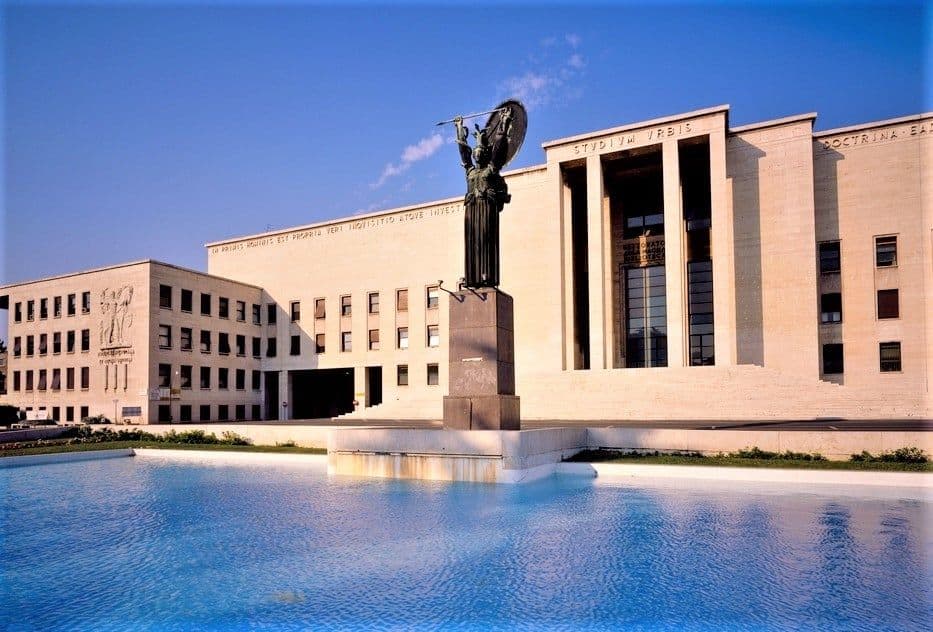

Sapienza University of Rome traces its origins to April 1303, when Pope Boniface VIII issued a bull establishing a Studium Urbis in the city, a centre of study answerable to the papacy rather than to the more self-governing scholarly corporations that had already formed at Bologna and Padua. Pope Eugene IV restructured the institution in 1431 and set its teaching around law, medicine, philosophy and theology. The name Sapienza, meaning wisdom, came into general use during the seventeenth century. The university stayed under papal authority until 1870, when Rome became the capital of a unified Italy and the studium was reconstituted as a state institution.
The university is now organised into eleven faculties and more than fifty departments spanning the natural and applied sciences, medicine, engineering, law, economics and the humanities. With an enrolment on the order of 109,000 students it ranks among the largest universities in Europe by headcount. Most teaching is concentrated in the Città Universitaria, a purpose-built academic quarter of roughly 44 hectares laid out by the architect Marcello Piacentini and finished in 1935 on a site adjoining the Campo Verano cemetery; its rationalist buildings were conceived as one planned precinct rather than an accumulation of separate colleges. Further faculties, teaching hospitals, libraries and laboratories are dispersed across other districts of Rome and a number of towns in Lazio.
Research covers a broad spectrum, though two strands are especially bound up with the institution. Classical archaeology and the study of antiquity draw on the university's setting and on excavation programmes run in Italy and abroad over many decades. In the physical sciences, Sapienza is associated with the group of physicists that formed around Enrico Fermi in the late 1920s and 1930s, whose work in nuclear and particle physics shaped much later Italian research in the field. The university also maintains one of Italy's largest academic library systems and issues publications across most of its disciplines.
Admissions & ranking
Source: EduRank ↗- World ranking
- #119
- Italy ranking
- #2 of 88
- Acceptance rate
- ~39%Estimated
Acceptance rate is an EduRank estimate — modelled from comparable institutions for universities that do not publish an official figure (2026). Verify with the university before applying.
Programmes
View all 60 →Sapienza University of Rome has 60 programmes listed on Stuudy.
Academics
Read more →Key Facts University Type: Public Research University Established: 1303 Location: Rome, Lazio, Italy International Students: 15% Specialization: Engineering, Medicine, Humanities, Sciences, Law Campuses: Multiple campuses across Rome History & Foundation Sapie…
Tuition & costs
See details →Tuition across programmes ranges around $3,260 – $3,394. Fees vary by programme and level.
Location
View location →Sapienza University of Rome is located in Rome, Italy.
How many programmes does Sapienza University of Rome offer on Stuudy?
Sapienza University of Rome has 60 programmes listed on Stuudy across various levels and disciplines.
Where is Sapienza University of Rome located?
Sapienza University of Rome is located in Rome, Italy.
What is the official website of Sapienza University of Rome?
You can visit the official website at https://www.uniroma1.it/.